Rotator Cuff Surgery Rehabilitation in Geneva: Full Protocol
Tendon healing demands strict progressive loading for six months. Rehabilitation moves through four phases: immobilisation and pendulum exercises, mobility recovery, muscle reactivation and return to activity, then strength work oriented towards sport. Driving is generally possible from week eight with the surgeon's clearance.
Contents
Protecting the Tendons During Immobilisation
For the first four to six weeks, the sling or abduction cushion is the single most important factor in healing. Any mechanical tension on the repaired tendons before they have consolidated can compromise the surgical result. This constraint is non-negotiable.
Strict immobilisation for 4 to 6 weeks. Pendulum exercises are prescribed from day one: movement is initiated by the trunk, not the shoulder muscles. Sleep semi-reclined to reduce overnight pressure on the joint. Pain that intensifies despite rest requires immediate contact with the surgical team.
Managing immobilisation and post-operative pain
The sling holds the arm in a neutral position and prevents harmful tension on the sutured tendons. Remove it only for prescribed exercises and personal hygiene. Use analgesics as prescribed: manageable discomfort is normal, severe pain is not.
Semi-reclined sleeping reduces intra-articular pressure and limits painful night-time waking. A pillow placed under the elbow on the operated side is usually enough.
Fever, redness or warmth around the scar, increasing swelling, acute pain despite rest: contact the surgical team immediately. Do not wait until the next physiotherapy session.
Maintaining distal mobility and starting pendulum exercises
Mobilise the hand, wrist and elbow several times daily. These joints were not operated on but stiffen quickly without movement. Five minutes of active mobilisation every two hours is sufficient.
Pendulum exercises are performed leaning forward with the unaffected arm resting on a table. The operated arm hangs freely toward the floor. Small swings or circles are initiated by the rocking of the trunk, never by shoulder muscle contraction. The exercise must remain completely pain-free.
Pain that intensifies despite rest is a signal to contact your medical team without delay.
Recovering Mobility Without Forcing
Once the initial inflammatory phase has passed, the focus shifts to recovering range of motion safely. The progression follows a precise logic: passive first, then active-assisted, then active independently.
From passive mobilisation to active-assisted movement
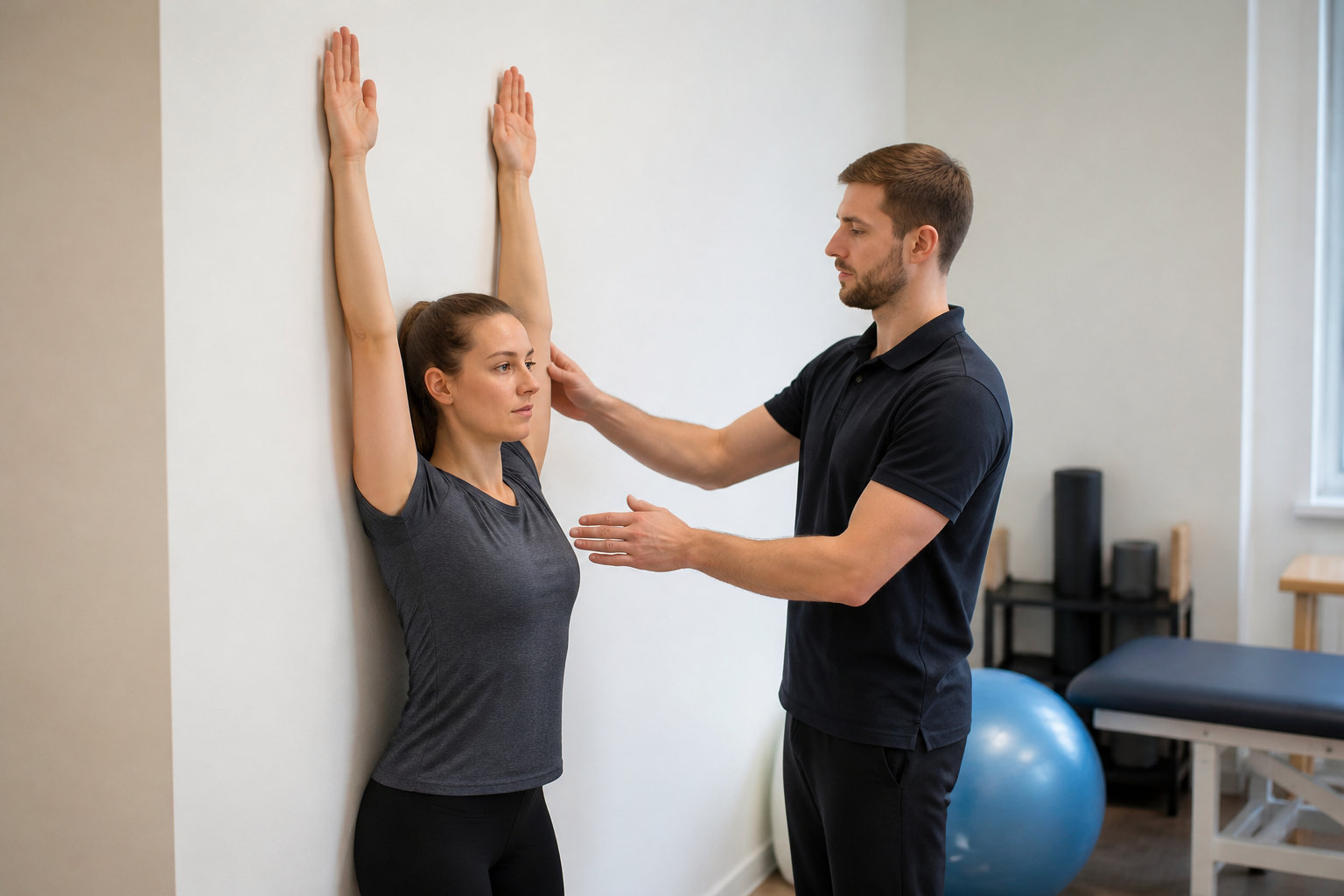
Table slides and wall slides build range of motion without loading the tendons. The unaffected arm guides the operated arm through trajectories defined by the physiotherapist. Consistent daily repetition is what produces progress, not the intensity of a single session.
Respect the pain threshold with every exercise. A mild stretching sensation is acceptable. Sharp pain is not, and signals that the range requested exceeds what the repair can tolerate at this stage.
Hydrotherapy is particularly useful during this phase. Buoyancy reduces the weight of the arm and allows trajectories that are difficult to achieve on land. If a rehabilitation pool is available, it is worth using.
Posture correction and scapular control
A rounded, forward shoulder reduces subacromial space and creates friction against the tendons with every movement. Correcting thoracic posture is therefore as much a protective measure as a mobility exercise.
Scapular retraction at end range trains the shoulder blade to set correctly. Without a stable scapula, the rotator cuff has to compensate for every movement, which slows recovery. This motor control work looks simple but requires concentration to do correctly.
Common compensations to watch for: hiking the shoulder to gain extra degrees of elevation, side-bending the trunk away from the operated shoulder, or pushing the head forward. Your physiotherapist spots these and corrects them before they become habits.
Shoulder rehabilitation in Geneva
No referral needed. Programme adapted to your healing phase and your goals.
Muscle Reactivation and Daily Activities
Surgery and immobilisation cause reflex muscular inhibition. The muscle no longer responds normally even when it was not directly damaged. Reactivation re-establishes that connection before asking for strength.
Recentring the humeral head through co-contraction
The deep rotators keep the humeral head centred in the glenoid during all arm movements. If these muscles do not activate correctly, the head migrates upward during elevation and presses against the acromion. That is both painful and counterproductive for healing.
Isometric exercises restart this activation without loading the tendons. Internal and external rotation is performed against gentle manual resistance with no visible movement. Positioning accuracy matters more than contraction intensity.
- Gentle co-contraction in neutral position
- Isometric work for internal and external rotators
- Attention to humeral head position throughout every exercise
Return-to-driving timeline and domestic activities
Driving is resumed between six and eight weeks depending on individual progress. The surgeon's formal clearance is mandatory: an emergency braking reaction puts the shoulder under peak load and can disrupt a repair that is still consolidating.

For dressing, always put the operated arm's sleeve on first and take it off last. No lifting until the physiotherapist gives clearance, even a half-full kettle. No pulling or pushing: the vacuum cleaner, shopping trolley and heavy doors wait.
Avoid all pulling and pushing movements for the first three months, including household tasks that seem minor. Protecting the repair takes priority over immediate independence.
Final Strengthening and Return to Sport
The last phase consolidates the gains made so the shoulder can handle sporting loads again: rapid movements and multi-directional forces without compensation.
Building proprioception and strength with resistance bands
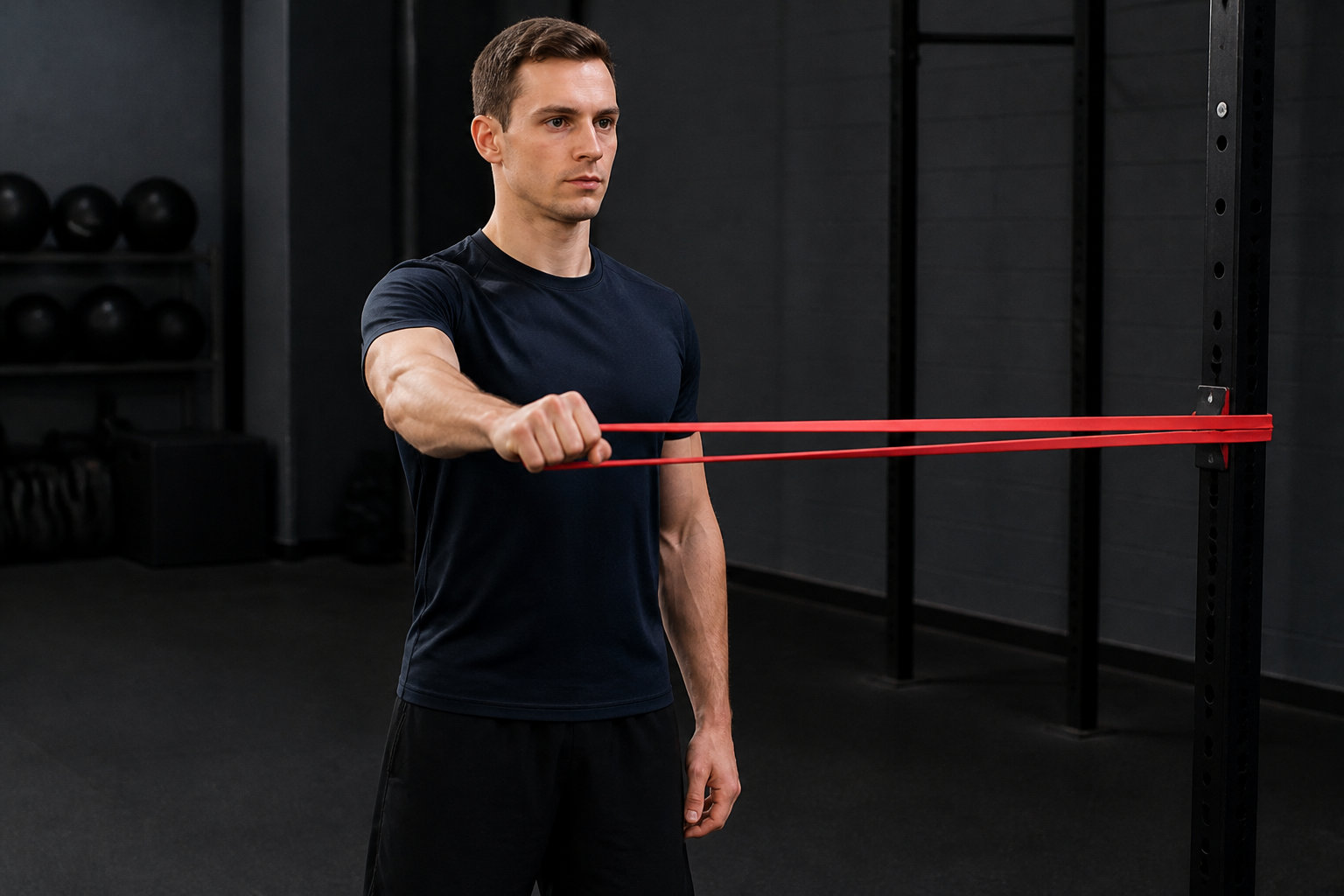
Elastic bands allow progressive resistance without heavy equipment. Start with internal and external rotations in neutral position, then vary the angles and ranges over the following weeks.
Proprioceptive work completes this phase. Exercises on unstable surfaces or in single-leg stance train the automatic stabilisation reflexes. The goal is for the shoulder to stabilise itself during fast movements without conscious effort.
| Phase | Goal | Key exercise | Duration |
|---|---|---|---|
| Initial | Protection | Pendulum | 0 to 6 weeks |
| Intermediate | Active mobility | Table and wall slides | 6 to 12 weeks |
| Reactivation | Muscle tone | Isometric then resistance bands | 3 to 6 months |
| Final | Strengthening | Plyometrics | 6 months plus |
Planning return to swimming, golf or tennis
Return to sport is gradual and depends on the discipline. For swimming, start with leg kicks alone, then integrate freestyle and backstroke before butterfly. For golf, the short game precedes the full swing by at least four weeks. For tennis, groundstrokes come before the serve, which places the greatest demand on the rotator cuff.
Plyometric work comes at the very end: rapid movements at the end of the kinetic chain. It prepares the tendons for sport-specific accelerations but requires a solid base. Do not introduce it before all the previous stages have been validated.
A shoulder-specific warm-up before every session and stretching at the end form part of the long-term maintenance routine. Prevention of recurrence depends on maintaining this work, not just on the duration of formal rehabilitation.
Frequently Asked Questions
Full recovery generally requires six months of structured rehabilitation. Functional improvement can continue up to a year after surgery, depending on the size of the tear repaired and the patient's age.
The process follows four phases: immobilisation, mobility recovery, muscle reactivation and strengthening. Each phase is validated by clinical criteria before moving to the next.
Driving is generally resumed between six and eight weeks post-surgery, once the sling is off and active range of motion is sufficient to manoeuvre without pain.
Formal clearance from the surgeon is mandatory before getting behind the wheel. An emergency braking reflex puts the shoulder under peak load and can compromise a repair that is still consolidating.
Any lifting, pulling, pushing or forced rotation must be avoided for the first six weeks. This includes tasks that seem minor: pulling a heavy door, lifting a kettle, vacuuming.
The no-pain rule applies to every movement. Any sharp pain calls for an immediate stop and a discussion with the physiotherapist.
Lean forward with the unaffected arm supported on a table. Let the operated arm hang freely toward the floor. Initiate small swings or circles using the momentum of the trunk, never the shoulder muscles.
The movement must remain completely pain-free. If pain appears, reduce the range or check your positioning with the physiotherapist.
Gentle sporting activity resumes progressively around three to four months. For swimming, start with leg kicks only. For golf, with the short game only.
Return to competitive or overhead sport (tennis, competitive swimming, CrossFit) generally requires four to six months of specialist rehabilitation, validated by functional tests.