Achilles Tendinopathy in Runners: Strengthening Protocols and Return to Running
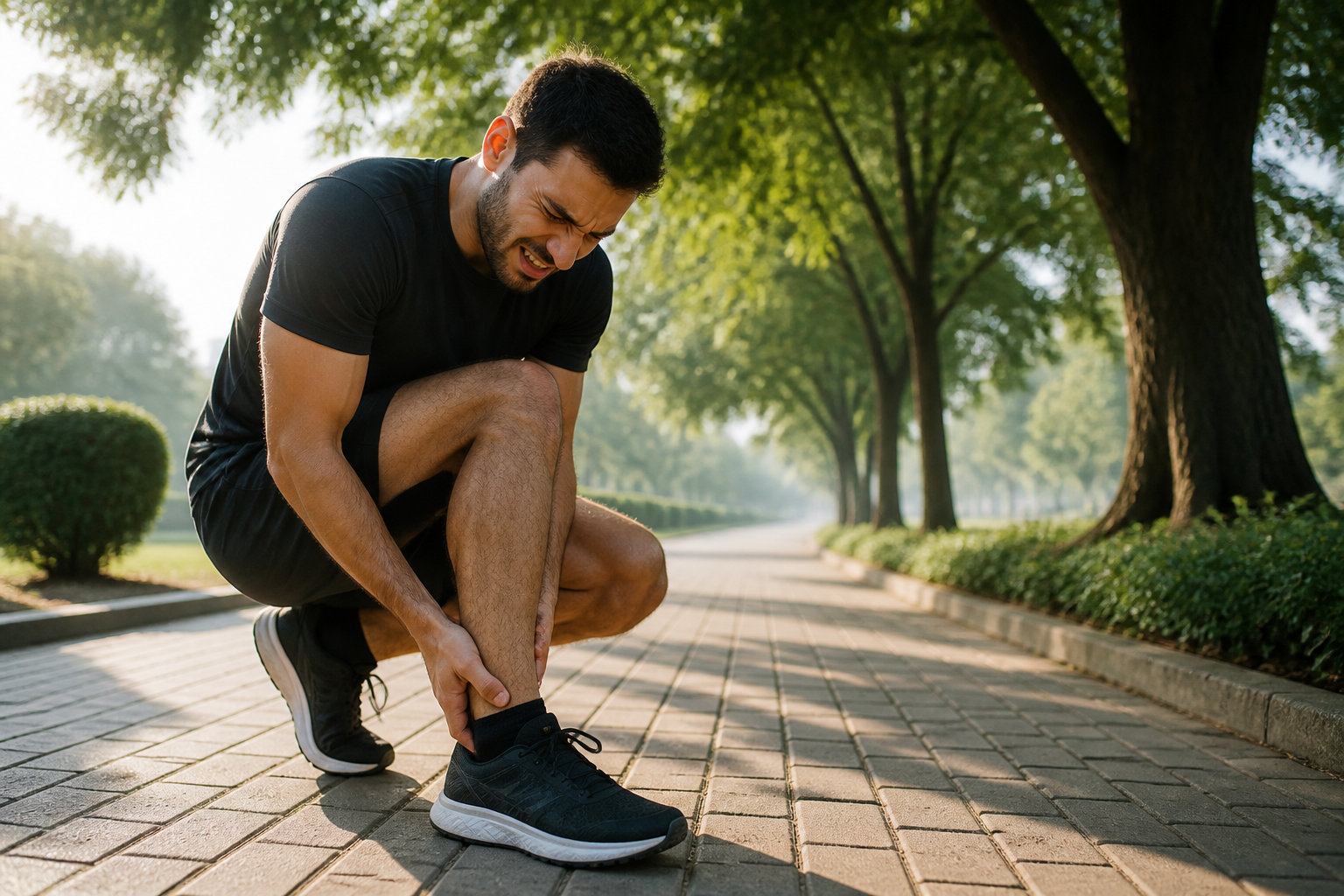
Achilles tendinopathy is not an inflammation to suppress but a mechanical overload signal. It affects around 10% of runners. Treatment centres on progressive loading — isometrics, the Stanish eccentric protocol and Heavy Slow Resistance — not complete rest. Adjusting running cadence reduces tendon stress durably.
Contents
Understanding Achilles Tendinopathy
Morning stiffness at the heel, a tender nodule, pain that builds gradually on longer runs: these are the signs of Achilles tendinopathy. Locating it precisely determines the rehabilitation programme.
Midportion and insertional forms
The midportion form sits 2 to 6 cm above the heel bone. This central zone is poorly vascularised, which slows tissue regeneration. It responds well to progressive eccentric loading.
- Midportion tendinopathy: pain 2–6 cm above the heel, often with a palpable nodule. Eccentric protocol indicated.
- Insertional tendinopathy: pain directly on the calcaneum, often related to footwear or bony morphology. Avoid direct compression on the insertion. Deep end-range dorsiflexion stretches should be limited in the acute phase.
The insertional form often involves a conflict with the shoe counter or a bony prominence. Treatment avoids direct compression on the insertion and adapts exercises accordingly.
Morning stiffness as a reliable indicator
Painful first steps at waking signal a tendon loaded beyond its current adaptive capacity. A visible or palpable nodule on the tendon body, a warm and tender zone: these are overload signals to regulate, not ignore.
Morning stiffness is a reliable indicator of tendon load status. It guides the intensity of the following session.
Triggering Factors
Training volume errors
A too-rapid increase in weekly mileage is the most frequent cause. The tendon lacks time to adapt to the imposed mechanical stress. The 10% maximum increase rule applies to both volume and intensity.
Drop and footwear
Shoe drop directly influences tension through the posterior chain. A minimum drop of 8 mm is generally recommended during rehabilitation. Transition to minimalist footwear must be very gradual even outside pain episodes.
Carbon plate shoes demand greater propulsive force and increase stress on the tendon fibres. Avoid them during active rehabilitation.
Overstriding and running cadence
Overstriding occurs when the heel strikes the ground well in front of the centre of gravity. This excessive lever arm imposes a sharp shock on the tendon with each stride. Increasing cadence above 170 steps per minute automatically reduces this lever arm. A slight knee flexion at ground contact absorbs some of the vibration.
Corticosteroid injections are formally contraindicated for the Achilles tendon. They significantly increase the risk of tendon rupture.
Three Strengthening Protocols
Isometrics: managing pain in the acute phase
Static calf raises (held still, leg straight) provide rapid pain relief without excessive mechanical stress on the fibres. Five sets of 45 seconds, once or twice daily, is a reliable starting point for restoring comfort within a few days.
Stanish eccentric protocol: rebuilding collagen fibres
Slow lowering of the heel over the edge of a step is the key exercise. Rise on both feet but lower slowly on the affected side, allowing the heel to drop below the step level. This eccentric movement stimulates collagen synthesis and restructures the tendon fibres. Lowering speed increases progressively over weeks. Pain should remain tolerable during the exercise and settle in the hours after.
Heavy Slow Resistance (HSR): structural strength
Heavy loading with slow, controlled movements through full range constitutes the advanced phase. This mechanical demand restores the tendon's capacity to absorb running impact over the long term. A 12-week period is needed for solid results.
| Phase | Exercise type | Intensity | Goal |
|---|---|---|---|
| Initial | Isometrics | 45 s hold | Analgesia |
| Intermediate | Eccentric (Stanish) | Slow lowering | Collagen synthesis |
| Advanced | HSR | Heavy loads | Structural strength |
| Return | Plyometrics | Progressive impacts | Return to running |
Tendon assessment in Geneva
No referral needed. Precise diagnosis and programme adapted to your training level.
Returning to Running Without Pain
Return-to-run criteria
Pain during the session must not exceed 3/10. Pain must have resolved the following morning: this is the most reliable criterion for adjusting the next session's intensity. The walk-run structure alternates 1 minute of jogging and 1 minute of walking, repeated 10 times. If no inflammatory response appears in the 24 hours after, volume increases progressively.
Morning stiffness is the true barometer. Mild discomfort during effort is tolerable if it stays below 5/10 and does not worsen after overnight rest.
Cross-training during rehabilitation
Cycling, swimming and aquajogging maintain cardiovascular fitness without impact on the tendon. They replace running effectively throughout the entire rehabilitation phase.
Complete rest is the tendon's enemy. Relative rest through non-impact activities maintains the tissue's adaptive capacity.
Posterior chain and ankle mobility
Tight calves pull constantly on the lower insertion. Working ankle dorsiflexion releases this permanent tension. Stable hips reduce parasitic foot movement at ground contact. Gluteal strengthening directly protects the Achilles tendon.
Frequently Asked Questions
Midportion tendinopathy affects the central tendon body, 2 to 6 cm above the heel. It is poorly vascularised and responds to eccentric loading. Insertional tendinopathy sits where the tendon attaches to the calcaneum, often linked to compression or bony morphology. The two forms require different exercise programmes.
Complete rest is generally not indicated. The tendon needs adapted, progressive mechanical loading to heal. Relative rest is preferable: keep moving as long as pain stays below 3/10. If running is too painful, cycling or swimming maintain fitness without tendon impact.
Three complementary protocols: isometrics (5 sets of 45 seconds on tiptoe) for immediate analgesia, Stanish eccentric protocol (slow heel lowering over a step) for collagen synthesis, and Heavy Slow Resistance with progressive loads for structural strength over 12 weeks.
Yes. Low drop increases posterior chain tension. A minimum drop of 8 mm is recommended during treatment. Carbon plate shoes increase stress on the tendon fibres and should be avoided during rehabilitation. Temporary heel raises can reduce tendon tension in the most painful phase.
No. Corticosteroid injections are formally contraindicated for the Achilles tendon. They significantly increase the risk of tendon rupture. Progressive loading remains the gold-standard treatment.