Tennis elbow: what physiotherapy can offer
Pain on the outside of the elbow, which comes back when you grip a handle, lift a kettle or use a mouse, quickly gets in the way of work and sport. It is often called lateral epicondylitis, sometimes “tennis elbow”, even in people who do not play tennis.
This article explains the mechanism, the place of physiotherapy, and what you can adapt in daily life. It does not replace an examination.
Why the tendon at the elbow wears
The tendons of the muscles that lift the wrist attach on the outer side of the elbow. Repeated efforts, especially in grip or with the wrist extended, place a load there. Over time, the tendon may tolerate that load less well. One then often speaks of tendinopathy of the extensors, rather than an isolated inflammation.
This distinction guides care: it is often a matter of gradually putting load back on the tendon, while reducing the movements that overwork it, rather than immobilising it for a long time.
The dominant arm is frequently the more uncomfortable one, but that is not a rule. Pain on the inside of the elbow points rather towards medial epicondylitis (golfer’s elbow), a different picture, which is also discussed with a health professional.
When to seek advice
If the pain settles in, a medical opinion makes it possible to rule out another cause (neck, nerve, joint, trauma). The doctor can, if needed, prescribe physiotherapy. You can also see a physiotherapist directly, as explained below.
Book more promptly if tingling or numbness appears in the arm or hand, if you have fallen on the elbow, if the neck is also painful, or if the discomfort does not change despite several weeks of adapting your movements.
Points to prepare for the appointment
This list does not make a diagnosis.
- Is the pain on the outside of the elbow, and does it come back when you grip or lift?
- How long has it lasted, and which work or sport movements bring it on?
- Is there tingling, numbness, or pain that starts in the neck?
- Have you already seen a doctor about this, and do you have a prescription?
Adapting movements, without immobilising the arm
Relative rest means reducing the movements that clearly bring the pain on, without leaving the arm inactive for weeks. You keep the movements you can tolerate, you break efforts into shorter bouts, and you pause more often.
At work, in DIY or in sport, you can often:
- limit screwing, hammering, very tight grips and vibrating tools, when that is possible;
- avoid working for a long time with the wrist broken upwards or the palm constrained;
- adapt the mouse, the grip of a tool or, in tennis, how you hold the racket, with tailored advice.
A counterforce brace, placed on the forearm, is sometimes tried to change the load on the tendon. Whether it is useful depends on your situation: ask whether it suits you, and how to wear it.
Ice
If cold eases the pain, wrap the pack in a cloth and do not apply it directly to the skin. Stop if the skin becomes painful or too cold. Cold does not replace adapting your movements or the exercises.
Progressive strengthening
Rehabilitation often starts with gentle stretches of the forearm muscles, in a comfortable range, then with light loading. The idea is to increase the resistance little by little, according to your pain and what you can tolerate, not to reach an “ideal” number of repetitions that would apply to everyone.
An exercise frequently suggested is to rest the forearm on a table, palm down, with the hand beyond the edge, then to lift the wrist and lower it slowly, first without weight. The controlled lowering (eccentric work) is often favoured. The exact pace, load and volume are set in the session.
Adjusting the load
The movement is done without sharp pain. Mild discomfort, which settles quickly afterwards, can be acceptable. If the pain rises clearly, or lasts into the next day, reduce the load and talk to your physiotherapist.
What is not enough on its own
Complete rest, if it goes on too long, does not generally help the tendon then cope with everyday efforts. Massage can be part of a session, but it is not, on its own, a rehabilitation plan.
Other options exist (braces, medication prescribed by the doctor, sometimes an injection). None of them is “the” single solution. Injections, including cortisone, are discussed case by case with your doctor: this is not a first-line treatment that the physiotherapist decides alone.
Immobility without advice
Do not stay still for weeks without talking to a professional. Another cause may sit behind the pain, especially if there is tingling, a trauma, or pain that starts in the neck.
How long can this take?
There is no standard duration. Recent discomfort can ease in a few weeks if movements are adapted. Pain that has been present for several months often needs more time. Progress is judged by a reduction of pain in useful activities, not by a date fixed in advance.
If nothing changes after several weeks of a well-followed programme, or if the pain gets worse, a further discussion with your doctor is useful. Sport, DIY or screen work are resumed in stages, keeping a margin of comfort, rather than all at once over a weekend.
What the physiotherapist does at the first session
The first session is an assessment. The physiotherapist asks you about your pain and your movements, then examines the elbow, the wrist and, if needed, the neck. This assessment helps to understand the symptoms and to identify what should be checked by a doctor.
Then a realistic goal is set with you: tolerating work, sport or everyday movements better. The first exercises stay light. You report any increase in pain, so that the plan can be adapted.
| Stage | What is aimed for |
|---|---|
| Understanding the movements | Identifying what brings the pain on at work or in sport |
| Relative rest | Reducing the overload, without stopping everything |
| Progressive reloading | Gentle stretches, then tailored strengthening |
| Return | Reintroducing useful efforts, in stages |
Seeing a physiotherapist in Geneva
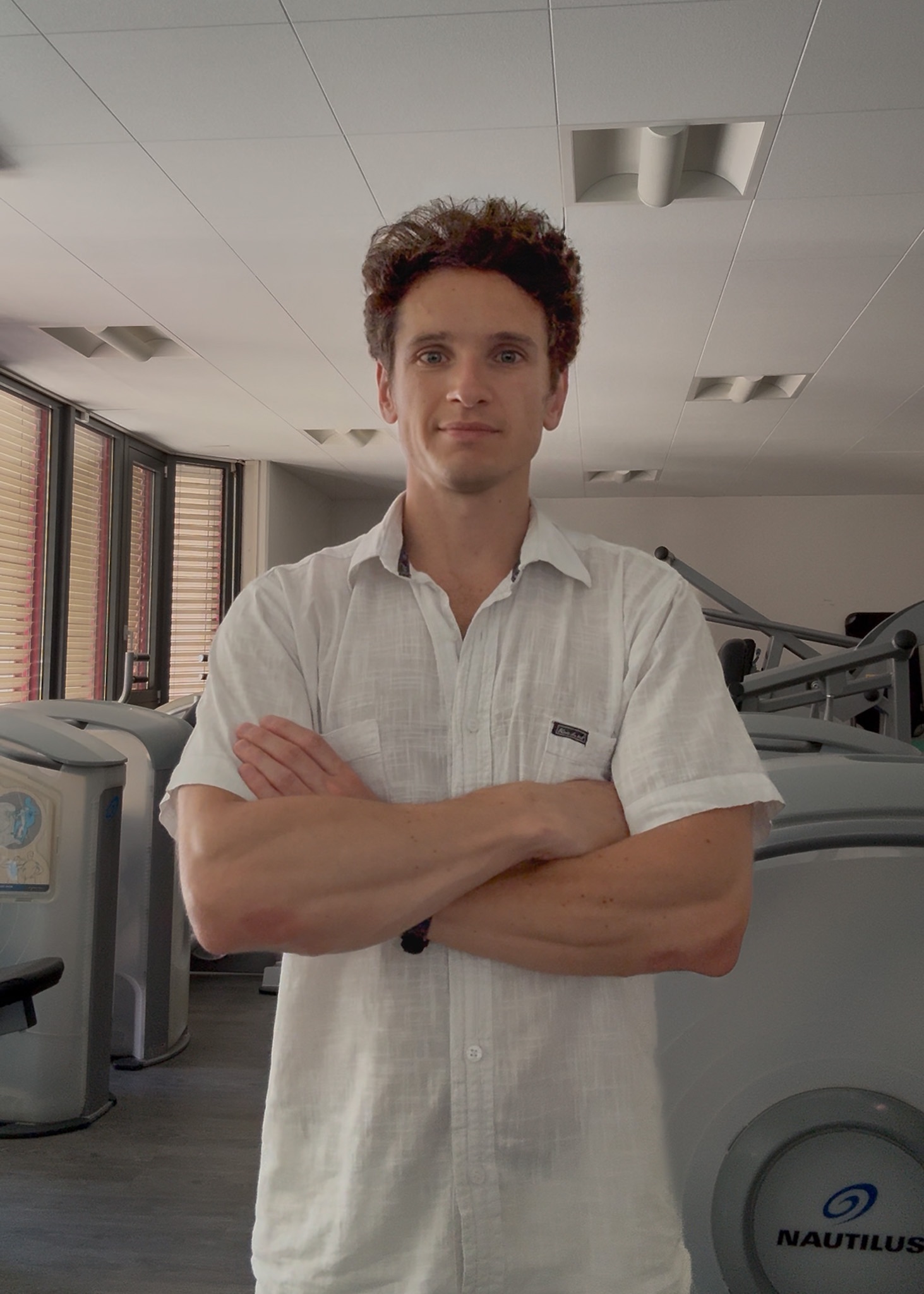
Samuel Monderer’s practice is at Rue du Vidollet 9bis, 1202 Geneva, within Strong Body Coaching, between Cornavin station and the Nations area. Consultations are in French, English and Italian.
Hours: Monday 7:30–12:30, Wednesday 14:00–20:30, Saturday 9:00–16:00. Appointments via OneDoc, on 076 268 25 62, or at contact@samuelmonderer.ch.
Sessions last 30 minutes. You can come without a prescription; LAMal only reimburses prescribed sessions. The practice fees are set out on the page session fees. If the pain also comes from repeated movements at the keyboard, the article on carpal tunnel exercises may be useful, without confusing the two pictures.
Frequently asked questions
Is massage enough for tennis elbow?
Usually not. Massage may ease the area for a moment, but it does not replace adapting painful movements and gradually loading the tendon. Ask your physiotherapist which exercises to start, and at what pace.
Do you need an X-ray to confirm tennis elbow?
Not necessarily. The diagnosis is most often based on a clinical examination by a doctor. Imaging is not routine. In Switzerland, it is the doctor who prescribes it if it is useful.
What is the difference between tennis elbow and golfer’s elbow?
Lateral epicondylitis (tennis elbow) affects the tendons on the outside of the elbow. Medial epicondylitis (golfer’s elbow) affects those on the inside. Where the pain sits is a clue, but an examination is still needed to rule out another cause.
Do you need a prescription to book in Geneva?
You can see a physiotherapist without a prescription. Basic health insurance (LAMal) only reimburses sessions prescribed by a doctor. Without a prescription, you pay for the session yourself, unless complementary insurance contributes under your contract.
This article offers general information. It does not replace an examination by a doctor or a physiotherapist.
Book an appointment at the practice
Rue du Vidollet 9bis, 1202 Geneva, within Strong Body Coaching. Consultations in French, English and Italian.
Monday 7:30–12:30 · Wednesday 14:00–20:30 · Saturday 9:00–16:00.
Or call 076 268 25 62
or write to contact@samuelmonderer.ch